
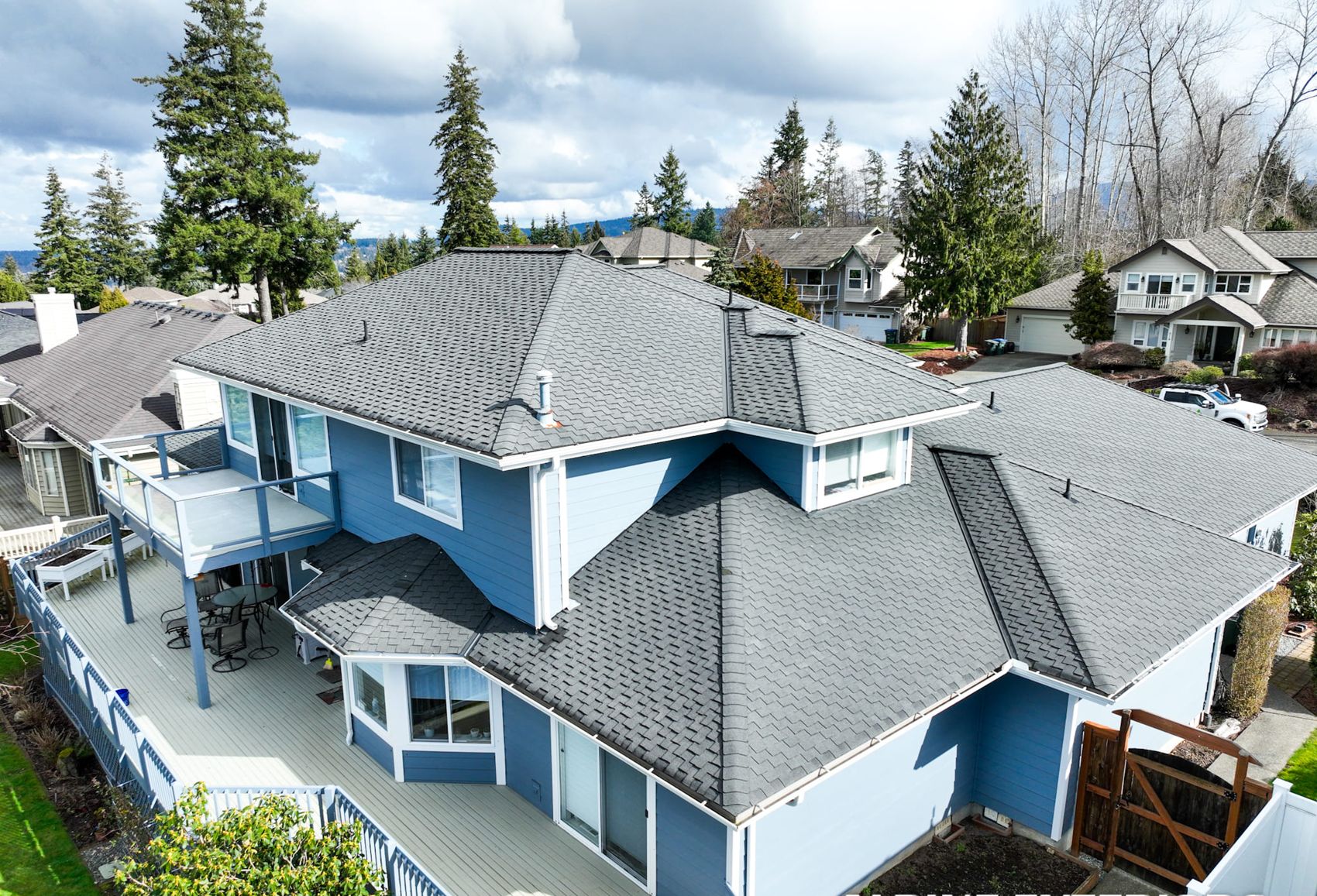
In Moon Lake and the rest of unincorporated Pasco County, siding damage after a storm is rarely just the cracked panel you can spot from the driveway. Wind-driven rain gets behind loosened or under-fastened panels and soaks the wall sheathing long before anyone notices a visible problem, so a storm that looked minor from inside the house can still leave a wet wall cavity working against you for weeks afterward.
That gap between what you can see and what's actually happening behind the panel is the reason storm-damaged siding in this part of Florida needs a closer look than a quick walk-around. The rest of this guide covers what's really going on behind the wall, why Pasco County's climate makes it worse than it would be elsewhere, and what to do about it before it turns into a bigger repair.
Siding is designed to shed water, not seal it out completely — every lap siding system, whether vinyl, fiber cement, or engineered wood, relies on overlapping courses and a water-resistive barrier underneath to manage the small amount of moisture that gets past the face of the panel in normal rain. Straight-line winds and tropical systems change that equation. When wind speeds climb, rain stops falling downward and starts moving sideways and even slightly upward against the wall, which is exactly the condition lap siding isn't built to handle. Wind-driven rain finds nail holes, lifted corners, gapped J-channel, and loose butt joints, and it pushes water behind the cladding instead of letting it run off the face.
Once water is behind the panel, the outcome depends on how long it sits there. Pasco County's humidity means a wet wall cavity doesn't dry out the way it might in a drier climate — the ambient moisture in the air slows evaporation, so damp house wrap, oriented strand board sheathing, or wood furring can stay wet for days. That's long enough for mold colonies to establish themselves on the back side of the siding and on the framing, and it's also long enough for wood-destroying organisms to take an interest. Subterranean termites, which are established throughout Pasco County, are drawn to consistently damp wood, and a chronically wet band at the base of a wall — often right where storm water pools after wind-driven rain — is a common place for termite activity to start unnoticed.
Separately from water intrusion, the siding material itself takes a beating from Florida's UV exposure even without a storm involved. Vinyl siding and the sealants used around trim, J-channel, and window returns become more brittle over years of intense sun, and brittle material cracks and pulls away from fasteners more easily when wind loads hit it. So a storm often doesn't create a new weakness out of nothing — it finds and exploits a weak point that sun exposure and thermal cycling had already been working on for years.
Moon Lake sits inland from the Gulf compared to New Port Richey, but it's still well within the wind exposure that matters for siding performance, and homes here see the same tropical systems, squall lines, and severe thunderstorm outflow that hit the coast. A few regional factors combine in a way that doesn't show up the same way in other parts of the country:
None of this means every home in Moon Lake is in trouble after every storm. It does mean that the same visible damage — a loose panel, a cracked corner piece — carries more downside risk here than it would in a milder, drier climate, simply because of what tends to happen behind the wall if it isn't addressed.
After any storm with sustained wind or heavy wind-driven rain, walk the full exterior of the house, not just the side that faces the street. Look specifically for panels that have lifted at the bottom edge, gaps that have opened at corner posts and J-channel, cracked or missing pieces, and staining or a soft feel to the wall surface near the base of the siding. Soft spots, dark streaking, or a musty smell near an exterior wall are signs that water has already gotten behind the cladding, not just signs that the surface got wet.
Document everything with dated photos before you touch or repair anything. If your homeowner's insurance policy includes wind mitigation credits, pull your current OIR-B1-1802 Uniform Mitigation Verification Inspection Form if you have one on file — it documents the building features (roof-to-wall connections, opening protection, and so on) that your insurer used to rate the policy, and it's a useful reference point when a claim is being evaluated, since it establishes what was already documented about the structure before the storm.
Resist the urge to caulk over a cracked panel or nail a loose section back down as a permanent fix. Sealing the surface without checking what's underneath can trap moisture that's already gotten behind the wall, which speeds up the mold and rot problem rather than solving it. If there's any reason to think water reached the sheathing — staining, softness, a musty smell, or simply a storm strong enough to have driven rain sideways for an extended period — that section needs to be opened up and checked, not just resealed.
When you're ready to have the damage assessed, work with a Florida-licensed contractor who can document the damage properly for an insurance claim and who understands what Florida Product Approval and current Florida Building Code wind requirements mean for the replacement materials. Alpine Exteriors holds Florida contractor license RB29003900 and works throughout the Tampa Bay area, including Pasco County communities like Moon Lake, New Port Richey, Land O' Lakes, and Wesley Chapel — a licensed contractor's assessment carries more weight with an insurance adjuster than a homeowner's own walk-around, and it gives you an accurate picture of whether you're looking at a spot repair or a larger section that needs to come off.
Coverage depends on your specific policy language and the cause of loss, so there's no universal answer — some policies cover wind damage well but exclude or limit coverage for water intrusion or mold that develops afterward, and how the claim is categorized matters. The best first step is to document the damage with photos as soon as you find it, avoid making permanent repairs before the damage is assessed, and have a licensed contractor's written assessment on hand when you file, since adjusters weigh professional documentation more heavily than homeowner observations alone.
Normal wear in this climate tends to look like gradual fading, chalking, or brittleness from UV exposure spread evenly across sun-facing walls, along with slow sealant breakdown at joints. Storm damage tends to be more localized and sudden — panels lifted or torn away on the side of the house that faced the wind, cracked corner trim, or fastener holes that have visibly elongated from panels flexing in high gusts. The two are related, though, since UV-weakened material is more likely to fail during a wind event than material in good condition.
Moon Lake doesn't face the direct salt air exposure that homes right on the Gulf coast deal with, so corrosion of fasteners and hardware is less of a driving concern than it is in beachfront parts of Pasco and Pinellas counties. The bigger factors for Moon Lake are the same regional ones that apply across inland Tampa Bay: wind pressure ratings tied to Florida Product Approval, resistance to humidity-driven moisture problems behind the wall, and UV durability, all of which matter regardless of how close a given lot is to the water.
It depends on how contained the damage is and how old the existing siding is. A handful of cracked or missing panels on an otherwise sound wall, with no sign of water having reached the sheathing, can often be spot-repaired, though matching older siding's color and profile isn't always possible if it's been discontinued or sun-faded over the years. If water intrusion, soft sheathing, or mold is found once a section is opened up, or if the siding is old enough that its Florida Product Approval no longer matches current code wind requirements, a larger section or full replacement is usually the more honest recommendation, even though it costs more up front than a patch.
If a recent storm left your Moon Lake home with lifted panels, cracked trim, or a wall that just doesn't look right anymore, it's worth having it looked at before the next round of Tampa Bay weather moves through. Alpine Exteriors, Florida license RB29003900, serves Moon Lake and the surrounding Pasco County communities — New Port Richey, Land O' Lakes, Wesley Chapel, Lutz, Zephyrhills, and Plant City — and can walk the exterior with you, document what's found, and give you a straight assessment of whether you're looking at a repair or a replacement. Reach out to schedule an inspection while the storm damage is still fresh and easy to document for your insurance claim.