

Moon Lake is a different animal from the newer platted subdivisions closer to Wesley Chapel or Land O' Lakes. Lots here tend to be larger, older, and shaded by mature live oak and slash pine canopy, with a mix of manufactured homes, ranch-style site-built houses, and lakefront properties around the lake itself. There's rarely a heavy-handed architectural review board dictating your palette down to the paint chip, but that freedom means the responsibility for picking a color that will actually hold up — and actually look right against the landscape — falls on the homeowner. We put this guide together after years of tearing off old siding and reinstalling new product on homes throughout unincorporated Pasco County, including plenty around Moon Lake, Old Dixie Highway, and the surrounding lake-and-oak neighborhoods.
For most Moon Lake properties, we steer homeowners toward mid-tone earth colors — warm grays, driftwood, dune tan, and muted clay or brick-red — over both very dark charcoal tones and stark, bright white. The reasoning is practical, not aesthetic. Dark siding absorbs far more solar heat under Pasco County's intense summer UV, which accelerates thermal expansion and contraction in vinyl panels and can shorten the visible life of the color coat. Bright white, by contrast, shows pollen, oak tannin streaking, and mold/mildew growth faster than a mid-tone does, especially on homes sitting under heavy tree canopy where humidity lingers on north-facing walls. A warm gray or driftwood tone splits the difference: it reflects enough heat to stay dimensionally stable, and it doesn't show every water spot and tannin drip the way white does. These tones also read naturally against the lake, palmetto understory, and oak canopy that define Moon Lake's landscape, rather than looking like they were dropped in from a stucco subdivision.
Not every criterion that matters in a coastal or urban market applies the same way in Moon Lake, so we weigh a specific set of local factors:
This has become our most common recommendation for Moon Lake homes over the past few seasons. It reflects more heat than darker tones, so panels run cooler and stay flatter over time, and it does a good job hiding light dust, pollen, and minor tannin streaking between washes. The downside: on homes with very little tree cover, a warm gray can look slightly flat or cool without some contrast from trim, shutters, or a stone/brick water table to break it up.
Tan and sandstone tones sit well against oak bark and palmetto, and they're forgiving of dirt and water spotting, which matters on a lot with a lot of overhead canopy dropping debris. They're also a safe bet if you're unsure whether your parcel has any recorded color restrictions, since tan reads as conservative almost everywhere. The tradeoff is that tan can look dated if the trim and roof aren't coordinated carefully — pairing it with the wrong roof shingle color is the most common mismatch we see on resales.
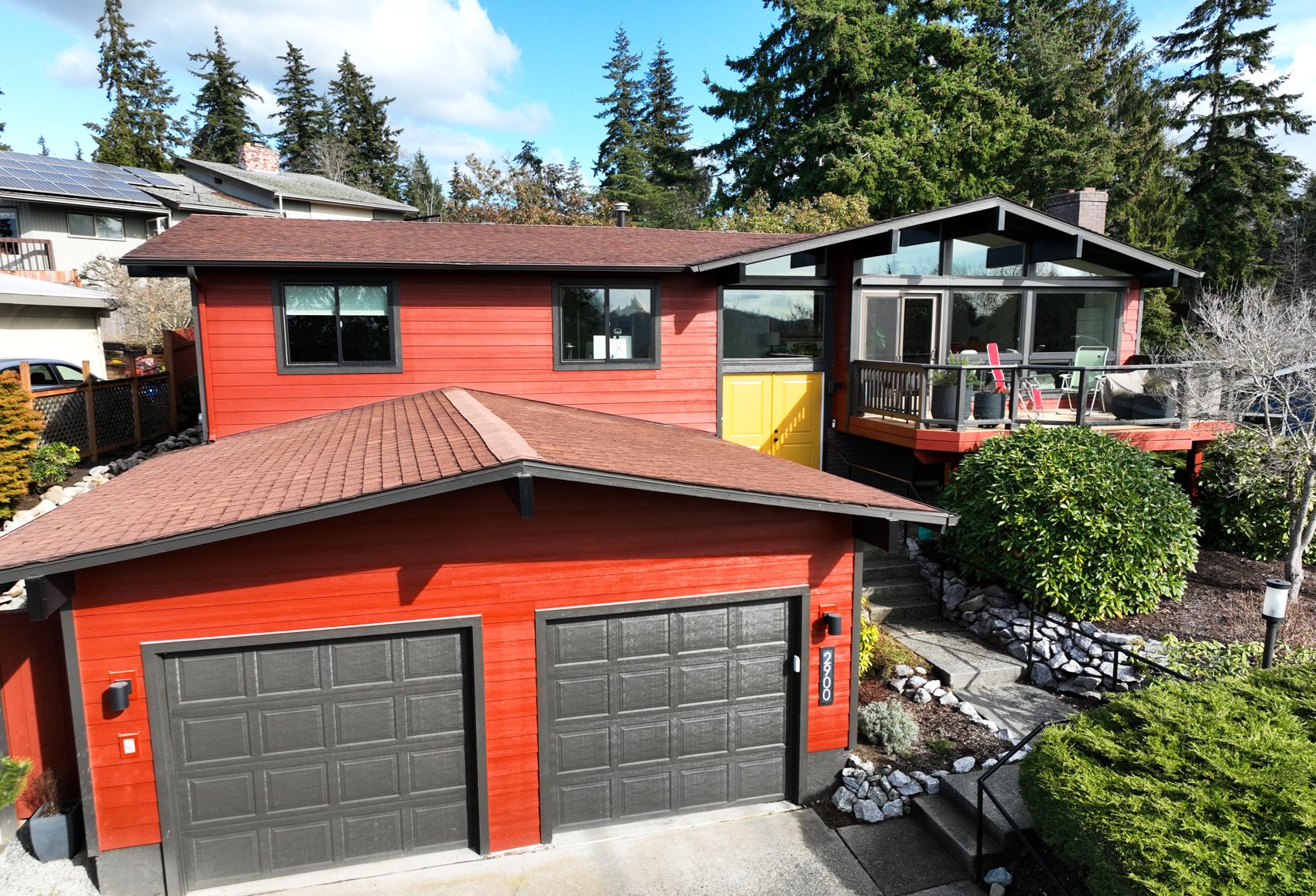
A toned-down terracotta or brick tone gives a home some warmth and personality without going bright, and it holds up reasonably well under UV compared to more saturated reds. It's a good option on lakefront lots where you want the house to stand out a little against green foliage. The downside is that clay tones can clash with certain brick or stone accents if they're not chosen together, and true saturated red or orange (as opposed to a muted clay) will fade faster and unevenly in direct Florida sun.
White still has a place, especially on homes with heavy trim detail or a more traditional look, and it doesn't carry the heat-absorption downsides of dark colors. But under oak canopy, white is the color most likely to show mold, mildew, and black streak staining within a year or two, particularly on north-facing walls that don't get direct sun to dry them out. If you love white, plan on more frequent soft-washing to keep it looking clean.
Dark, modern charcoal siding has gotten popular in newer developments closer to Wesley Chapel, and it can look sharp on a contemporary build. In Moon Lake's climate, though, it's the color we're most cautious about recommending. It absorbs significantly more heat, which increases thermal cycling stress on the panels, and it will show dust, pollen, and water spotting in a way that's more visually obvious than on a mid-tone. We still install it when a homeowner wants that look, paired with a quality product rated for higher heat tolerance, but we walk through the tradeoffs first.
Beyond individual color choices, a few patterns cause regret in this area. Avoid very dark colors on any wall with long, unbroken sun exposure — the heat buildup and fade are worst there, and it's also where wind-driven rain during storm season hits hardest, which shows up as visible streaking against a dark background faster than against a mid-tone. Avoid stark white if your lot has heavy tree canopy over the roofline, since that's exactly the setup that produces mildew staining fastest. And avoid picking a color in isolation from the roof and trim — Moon Lake's lots are visually tied to their surroundings more than a subdivision with uniform landscaping, so a color that looks good on a sample chip can look off against your actual oaks, lake view, or existing brick. Finally, whatever color you land on, make sure the underlying product carries current Florida Product Approval and meets Florida Building Code wind-load requirements for this area — the color is cosmetic, but the panel's ability to stay attached in a tropical storm is not, and it's worth confirming with your OIR-B1-1802 wind mitigation inspection how your existing exterior is rated before you decide whether you're doing a full re-side or a partial repair.
Yes, generally. Central Florida gets more direct, higher-intensity UV exposure across more months of the year than northern climates, and darker pigments break down faster under that exposure. It doesn't mean dark siding is unusable here, but you should expect more visible fading over time on south- and west-facing walls compared to a mid-tone or light color, and you should ask your contractor about the specific product's UV warranty terms rather than assuming all vinyl colors age the same.
It depends on the specific parcel. Much of Moon Lake is unincorporated Pasco County without a mandatory architectural review board, but some newer developments and certain platted lakefront sections do carry recorded deed restrictions on exterior colors. Before you order material, check your property's recorded plat and any covenants with the Pasco County Clerk of Court, or ask your contractor to help you track that down, since correcting a color after installation is far more expensive than confirming it up front.
Homes under heavy oak canopy near the lake tend to stay more humid, longer, on shaded walls, which speeds up mold and mildew growth regardless of siding color, though it shows up faster on white and other very light tones. Oak tannin from leaves, pollen, and acorn debris also streaks siding over a season, so a mid-tone that hides that kind of staining between cleanings will generally look better, longer, than a stark white or very dark color.
Yes, and it's a common approach on larger or lakefront homes in this area — a lighter or mid-tone body color with a darker accent on gables, shutters, or a lower band can add depth without taking on the full heat-absorption downside of an all-dark exterior. The key is making sure both colors are from the same product line so their fade rates and thermal behavior are comparable over time, rather than pairing mismatched materials that age differently.
Every Moon Lake lot is a little different depending on tree cover, sun exposure, and how close you are to the water, so a color that works two doors down might not be the right call for your house. Alpine Exteriors (FL license RB29003900) has installed and repaired siding throughout Pasco County, including Moon Lake, New Port Richey, Land O' Lakes, and the surrounding communities, and we're glad to walk your specific property, look at your sun exposure and canopy, and put together options that balance how it looks with how it actually holds up. Reach out to schedule a walkthrough and get a straightforward, no-pressure recommendation.